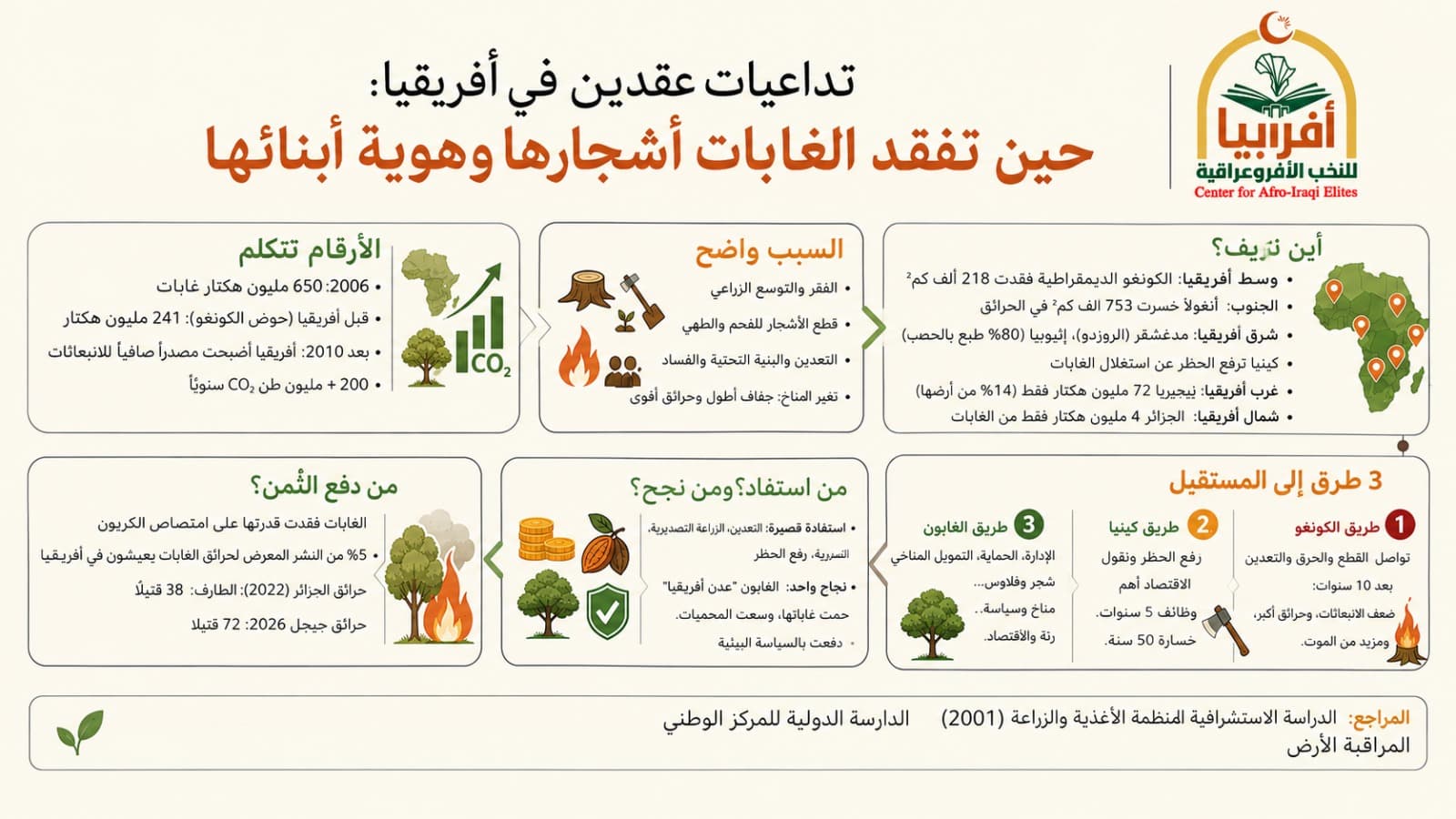
The Consequences of Two Decades in Africa: When Forests Lose Their Trees and Their Children Lose Their Identity
Africa’s forests have faced growing pressure between 2006 and 2026 from agricultural expansion, dependence on fuelwood and charcoal, timber extraction, mining, drought and wildfires. Since 2010, the continent has become a net source of carbon dioxide emissions, alongside substantial losses in forest biomass. The causes vary across regions: forest-cover loss is particularly severe in the Congo Basin, while fires and slash-and-burn agriculture are major pressures in the south, biomass dependence in the east, and commercial agriculture in the west. The Democratic Republic of the Congo has recorded extensive forest loss, while Gabon has maintained forest cover across 88% of its territory. Kenya, meanwhile, has moved toward expanding commercial forest exploitation.