

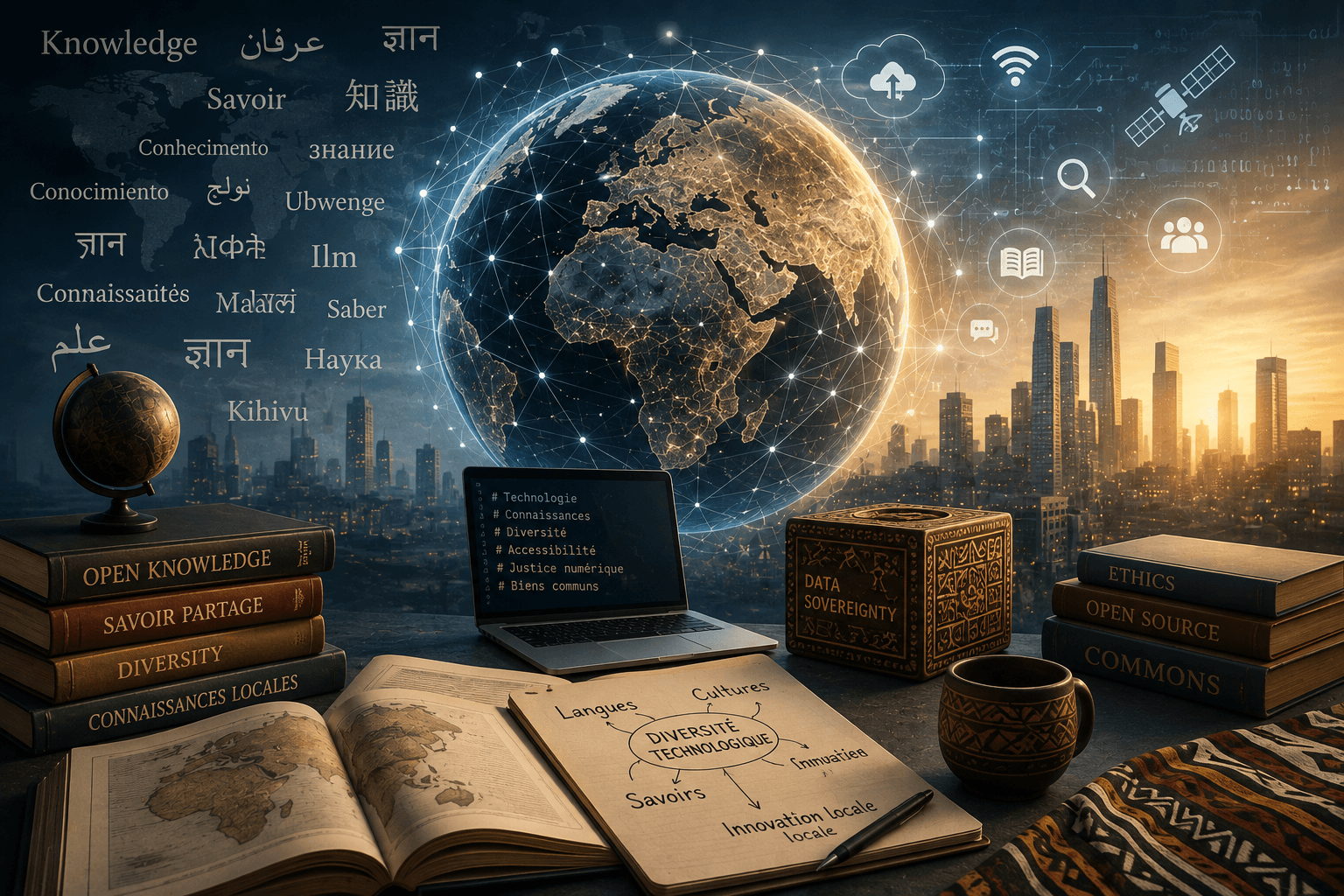
Those who control technology control more than the tools themselves; they also control part of the path through which knowledge travels. The networks that connect people, the software they use, the platforms through which they search for information, and the algorithms that determine what reaches them have all become part of everyday life, as well as of the production and circulation of knowledge. As these tools become concentrated in the hands of a limited number of companies, another problem emerges—one that goes beyond technology itself: what happens to languages, cultures, and forms of knowledge that are not given sufficient space within this system?
Domenico Fiormonte places this question within a broader discussion of the “algorithmic empire” and digital colonialism. Technology may appear uniform on the surface, but it does not necessarily operate in the same way everywhere, nor does it afford all languages and cultures the same degree of space. The question of technological diversity therefore becomes inseparable from the ability of societies to develop, protect, and sustain their own technologies and knowledge, rather than simply consuming models designed elsewhere.
Digital Knowledge at the Heart of the Struggle
The web and its technologies have become the space where politics, health, education, scientific research, the economy, and social relations now intersect. With this transformation, cultural, social, legal, and economic structures are no longer separate from technology. Instead, they have become intertwined with what Fiormonte calls the “algorithmic empire.”
Control takes different forms. The geopolitics of digital knowledge encompasses wired and wireless communication networks, applications, software, data centers, as well as the minerals and rare earth elements used to build and operate these systems.
Owning armies, natural resources, economic power, universities, or media outlets is therefore no longer sufficient on its own. These resources lose part of their capacity to exert influence when control over infrastructure and communication tools is absent.
Fiormonte connects this transformation to the ideas advanced by Canadian economist Harold Innis concerning the political, cultural, and ideological constraints and boundaries carried by technology. The material foundations of any technology are not entirely neutral, since they are shaped by those who design and control them.
Just as the modern publishing industry in the 1930s and 1940s depended on physical supplies of paper pulp, communication today is impossible to imagine without network infrastructure.
When Language Becomes Part of the Problem
The issue does not stop with the dominance of major corporations over the market. It is also a cultural challenge. Standardizing communication standards facilitates the widespread adoption of protocols, algorithms, and software, but it can also affect diversity.
This is particularly evident in the linguistic sphere. Google Search is available in 149 languages, while Google Maps is available in more than 70. According to other sources, the search engine can support as many as 348 languages. Yet the company’s advertising division announced in November 2020 that it operated in only 49 languages, more than half of them European.
The Ethnologue database contains more than 7,000 living languages, revealing the scale of the gap between actual linguistic diversity and what one of the world’s largest digital companies is capable of representing through its tools.
Fiormonte does not regard this disparity as merely a technical outcome. Technology giants need to outpace their competitors in order to maintain their positions, a process that American media scholar Jaron Lanier calls the “lock-in effect”—the restriction of innovation and the protection of existing technologies.
Decolonizing Knowledge
The debate over technology leads to a broader question concerning knowledge itself. In Fiormonte’s argument, technological diversity cannot be separated from linguistic, cultural, and biological diversity. Nor can it be achieved without reconsidering the position of regions that are commonly described as peripheral.
The material resources that make digitization possible are concentrated in regions of the Global South, but the issue extends beyond resources. The destruction of competing forms of knowledge was one of the factors behind underdevelopment. Frantz Fanon addressed this in The Wretched of the Earth, discussing a form of colonialism that goes beyond the extraction of resources and labor to include the destruction of indigenous cultures.
Fanon also links colonial domination to convincing the colonized of the inferiority of their own culture. Once local knowledge loses its value in the eyes of those who possess it, an external model becomes a standard that is easier to adopt.
From this perspective, addressing the technological imbalance between the North and South of the planet does not simply mean transferring technologies from North to South. What is required, according to this argument, is to encourage the development of sustainable local technologies that respect linguistic, cultural, and biological diversity.
Yet this places regions of the Global South before a question concerning how to build their own infrastructure while, at the same time, dealing with groups that possess the power to grant them access to resources and dominant discourses. Another question emerges as well: what price might diversity pay for visibility and access?
Innovation from the Global South
Despite this dilemma, various projects have emerged across countries of the Global South seeking to establish different forms of engagement with technology and knowledge. Fiormonte points to initiatives ranging from local data sovereignty projects to the movement for non-aligned technologies, big data projects, and initiatives inspired by the commons, alongside the growth of social networking movements in Asia, Africa, and Latin America.
Latin America offers another example through open-access scientific publishing initiatives, including systems and platforms such as Redalyc, SciELO, and AmeliCa, which challenge the paid publishing system and the cultural dominance of the English language.
These projects may appear limited when measured against the scale of massive foreign investment, but the transformation advocated by this perspective cannot be measured solely by the volume of funding. The issue also concerns what Kenyan writer Ngũgĩ wa Thiong’o calls the “decolonization of the mind.”
On this basis, regions that were once treated as mere recipients of technological models are no longer simply on the receiving end. Different approaches to preserving knowledge in digital forms, making it accessible, and transmitting it are beginning to emerge, opening the possibility of a multicultural technological diversity that is more equitable and sustainable.
The central idea remains that technology is not separate from language, culture, or knowledge. The ways in which technology is produced, distributed, and used largely determine the space available to different societies within the digital world. Technological diversity is therefore connected to an attempt to establish a different relationship with knowledge—one based not only on consuming what is produced elsewhere, but also on enabling the production, preservation, and circulation of alternatives.