Hausa communities and their language constitute one of the most prominent civilizational and anthropological blocs in West Africa and the Sahel-Sahara region, and are regarded as the largest ethnic groups on the African continent. A reading of the political and cultural history of this vast region cannot be complete without exploring the early foundations of the Hausa kingdoms, examining the development of their language, and tracing their demographic expansion beyond the geographical frameworks and political borders of modern African states. The number of Hausa speakers, whether as a mother tongue or as a shared language of communication, trade, and religious outreach, exceeds 250 million, placing Hausa eleventh in the world.
History of the Hausa Tribe and Kingdoms: Foundational Structure and Cultural Development
The historical narrative of the emergence of Hausa communities draws on a combination of documented oral traditions, historical records written in Ajami, and colonial documents. The famous founding legend traces its origins to Bayajidda, a hero who, in historical analysis, symbolizes waves of acculturation and migration from the east. These movements contributed to the formation of the cultural and social identity of the indigenous Hausa groups that came together under its banner.
The nineteenth century witnessed a structural transformation in the region's cultural and political geography following the Fulani jihad led by Usman dan Fodio in 1804. It resulted in the incorporation of Hausa communities into the Sokoto Caliphate, giving a central role to religious administration, Islamic legitimacy, and intellectual production in the region.
This historical background is closely connected to the role of Hausa as a principal vehicle for Islam in West Africa. Through the language, Islam and its creed spread among diverse clans and ethnic groups that adopted Hausa identity and became integrated into the Hausa cultural sphere through the efforts of scholars and preachers. Hausa was not merely a language of communication; it became a language of religion, trade, and administration, as well as a repository of complex forms of knowledge, including mathematics, medicine, and wisdom, extending to the observation of the movements of planets and stars and the study of astrological signs to determine times and organize travel, agriculture, and hunting.
This civilizational momentum was also reflected in literature and popular mythology. Historical drum literature emerged as a means of recording the political events of past centuries, alongside epic narratives commemorating the exploits of heroic horsemen such as Sadoki, kings and sultans known as Sarakai, and queens known as Saruniya. These historical origins also intersect with research hypotheses suggesting ancient cultural and linguistic links and points of convergence between Hausa civilization and the Nubian and Pharaonic heritage of northern Sudan. These are reflected in similarities in names, titles, and archaeological landmarks between northern Nigeria and northern Sudan.
The Status of the Hausa Language: Linguistic and Sociolinguistic Structure
Hausa is academically classified within the Chadic branch of the Afroasiatic language family, linking it to shared Semitic linguistic origins with its sister language, Arabic. Linguistically, it is characterized as a tonal language that relies on changes in pitch to determine the morphological and lexical meanings of words.
Hausa underwent two principal stages in its written history:
- The Ajami script: This is the use of a modified Arabic script adapted to the particular sounds of Hausa. It draws on the aesthetics of the Sudanese-Maghrebi calligraphic tradition widely used in writing Qur’anic texts, the transmission of the Warsh reading from Nafi‘, and Tafsir al-Jalalayn. This script was adopted for recording the books and works of Hausa scholars in fields such as Islamic law, astronomy, and literature from the fifteenth century onward.
- The Boko script: This is the use of a modified Latin script, introduced by the colonial administration and European missionaries in the twentieth century to rewrite the heritage and marginalize its Arab-Islamic manifestations. It later became entrenched in official educational and media systems. Military field usage also produced specialized varieties derived from Hausa, such as Barikanchi, within military institutions.
The sociolinguistic strength of Hausa lies in its role as a common lingua franca used in commercial, political, and religious transactions among multiple ethnic groups, giving it a demographic weight that extends beyond the number of its native speakers.
The Geography of Hausa's Global Spread
The linguistic and cultural geography of Hausa extends across a broad belt stretching from the shores of the Atlantic Ocean in the west to the Nile Basin and East Africa, reaching into global diaspora networks.
The population density and linguistic use of Hausa are distributed across several areas:
- Nigeria and Niger: Northern Nigeria and the Republic of Niger constitute the principal political and demographic stronghold of Hausa, where it is regarded as an official and unifying national language.
- Ghana, Benin, Togo, and Burkina Faso: Hausa is widespread in urban Zongo communities, where it serves as an official or common language of communication and trade among Muslims and different ethnic groups.
- The Lake Chad Basin and Central Africa: Its presence extends to Chad, Cameroon, Gabon, the Republic of the Congo, and Côte d’Ivoire.
- East Africa and Sudan: Historical and settled Hausa communities are found in Sudan, Eritrea, and Ethiopia. They have maintained their linguistic identity while becoming fully integrated into local societies.
- The global diaspora: Its presence extends to the Arabian Peninsula, particularly the Hijaz region of Saudi Arabia, where Hausa families are known as a result of historical migrations associated with the pilgrimage seasons, in addition to communities spread across North Africa, Europe, and North America.
World Hausa Language Day: Initiative, Organization, and Celebratory Form
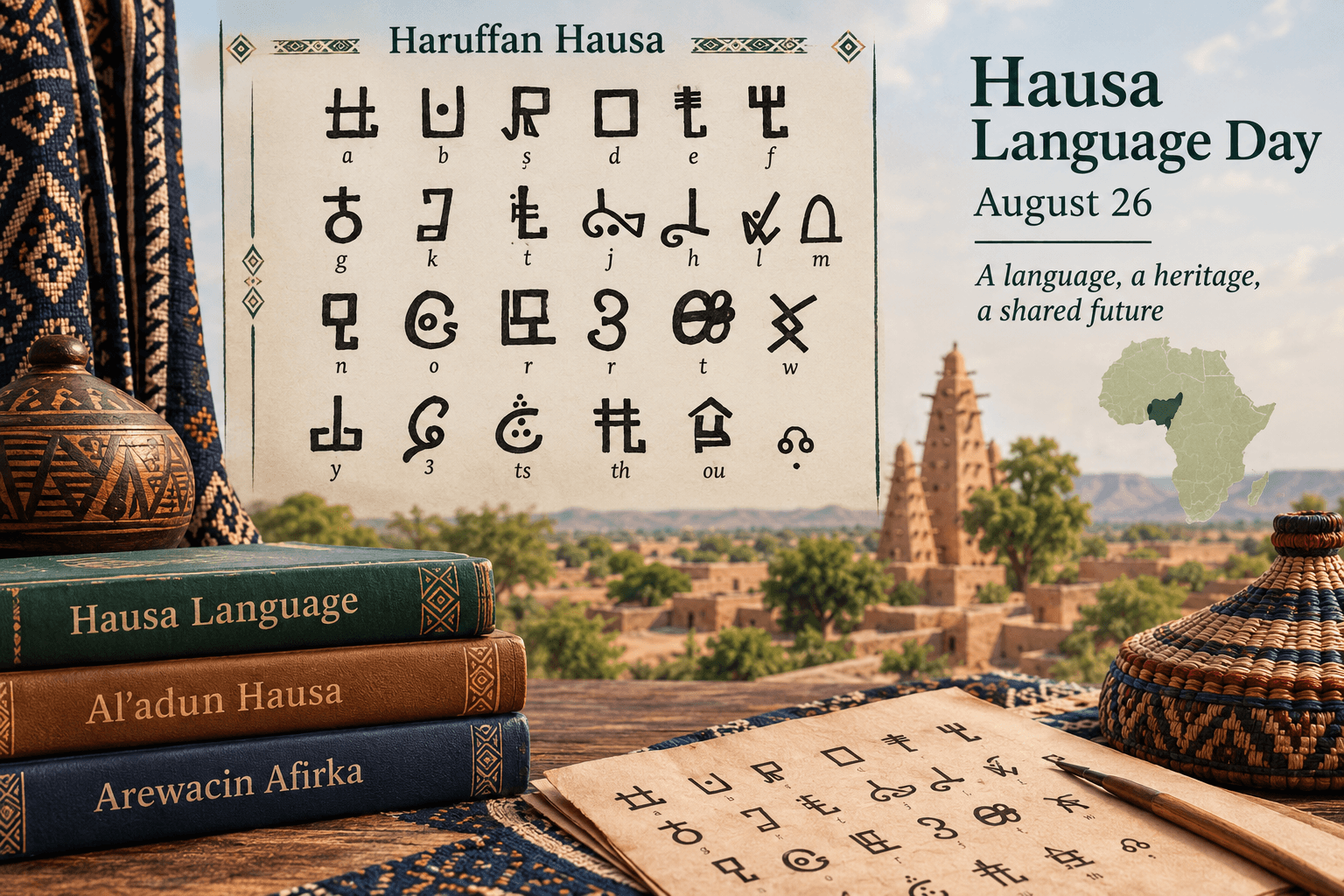
The establishment of World Hausa Language Day, known in Hausa as Ranar Hausa, dates back to 2015, following an initiative launched by Nigerian journalist Abdullahi Aliyu Jari through social media. The primary objective was to mobilize Hausa speakers and direct efforts toward strengthening digital content in Hausa, promoting literature and heritage, and developing modern technical terminology.
The twenty-sixth of August each year has become an international occasion that extends beyond the digital sphere to include broad field-based and academic activities, with forms of celebration varying from one country and region to another:
In Nigeria: Festivals are held in historic capitals, universities, and research centers such as the Hausa Language Development Centre in Kaduna. Celebrations include traditional equestrian displays known as Durbar, competitions in popular sports such as dambe, a traditional form of wrestling, as well as oral seminars, poetry-reading evenings, and demonstrations of writing in both the Ajami and Boko scripts.
In Ghana and the diaspora: Zongo neighborhoods in Accra, along with gathering centers in Khartoum, Jeddah, Istanbul, and Nairobi, host festivals that bring together traditional leaders, scholars, and academics. These events feature classical musical performances, comedic and dramatic plays, displays of embroidered traditional clothing, and traditional foods.
The Future of Hausa and the Digital Future
The continuity of Hausa in the modern era depends on its ability to adapt to digital media, artificial intelligence, and content production. The transition of the language from oral forms and traditional writing to digital platforms requires computational linguistic processing capable of supporting the tonal features and complex sounds of Hausa.
The recent development represented by the adoption of Hausa as an official language in Niger in March 2025 provides an additional political and institutional impetus for expanding its use in administration, higher education, and judicial institutions. This coincides with the expansion of international radio stations, satellite television channels, and digital platforms targeting Hausa-speaking audiences, helping preserve oral and literary heritage and develop technical dictionaries suited to the requirements of modern science and technology.
A reading of the historical and future trajectory of Hausa confirms that it has never been merely a means of human communication. It has been, and remains, a vehicle for transmitting civilization, trade, and intellectual life across the Sahel and West Africa. Amid rapid digital transformations and the political recognition represented by the latest constitutional declaration in Niger in 2025, linguistic initiatives such as Ranar Hausa have reached a stage of historical maturity. The annual celebration has thus moved beyond a merely symbolic event toward a comprehensive sociolinguistic strategy aimed at ensuring that Hausa remains a living language capable of knowledge and digital production, and a bridge connecting the Hausa imperial past with the contemporary future of its coming generations.
References
- Adamu, M., The Hausa Factor in West African History (Zaria: Ahmadu Bello University Press, 1978).
- Furniss, G., Poetry, Prose and Popular Culture in Hausa (Edinburgh: Edinburgh University Press, 1996).
- Heine, B., & Nurse, D. (Eds.), African Languages: An Introduction (Cambridge: Cambridge University Press, 2000).
- Jaggar, P. J., Hausa (Amsterdam: John Benjamins Publishing, 2001).
- Last, M., The Sokoto Caliphate (London: Longmans, 1967).
- Lovejoy, P. E., Caravans of Kola: The Hausa Kola Trade (1700-1900) (Zaria: Ahmadu Bello University Press, 1980).
- Newman, P., The Hausa Language: An Encyclopedic Reference Grammar (New Haven: Yale University Press, 2000).
- Philips, J. E., "Writing African in Ajami: The Arabic-script Writings of Hausa and Other West African Languages", African Studies Review, 47(3) (Cambridge: Cambridge University Press, 2004).
- Smith, M. G., Government in Zazzau, 1800–1950 (London: Oxford University Press for the International African Institute, 1960).
- Journal Officiel de la République du Niger, Charte Constitutionnelle du mois de mars 2025 portant proclamation des langues nationales comme langues officielles (Niamey: Imprimerie Nationale du Niger, 2025).