Iraqi cities, foremost among them Najaf al-Ashraf, Karbala, Baghdad, and the other governorates, commemorate the birth of the Noble Prophet Muhammad, peace and blessings be upon him and his Family, on the seventeenth of Rabi' al-Awwal each year. The occasion is both religious and national, bringing together expressions of faith and popular joy. For Iraqi society, this anniversary has long represented a profound spiritual occasion that extends beyond worship to encompass cultural, social, and intellectual dimensions.
In Iraq, the birth of the Noble Prophet Muhammad, peace and blessings be upon him and his Family, is far from an ordinary occasion. It becomes a season of learning, preaching, religious gatherings, and seminars. Minarets are illuminated, streets are decorated, circles for religious study and Qur'an recitation are held, charitable donations are distributed, and communal meals are served. The occasion also highlights Iraq's particular character as a land of shrines and holy sites, as well as a land of scholars and thinkers who have carried the authentic Muhammadan message of Islam.
The blessed anniversary also coincides with the birth of his grandson, Imam Ja'far ibn Muhammad al-Sadiq, peace be upon him, giving the occasion an added intellectual and religious dimension. Imam al-Sadiq represents an extension of the Prophetic school in thought, jurisprudence, and ethics. He played a leading role in establishing the scholarly methodology followed by the followers of the Ahl al-Bayt, peace be upon them, which preserved the Prophetic heritage from distortion and loss. Scientific and cultural initiatives organized by religious seminaries and research centers have therefore emphasized that commemorating the Prophet's birth is not merely a matter of ritual; it is also a renewal of the commitment to the Prophetic project of building the individual and society.
The Prophetic tradition remains a living source from which peoples derive their values, ethics, and approach to coexistence. It also provides an opportunity for self-reflection and a return to the values established by the Noble Prophet: mercy, justice, tolerance, and unity. This year witnessed broad participation from religious, academic, and youth institutions, reflecting growing awareness of the importance of drawing upon the Prophetic tradition in confronting hate speech and extremism.
Dar al-'Ilm of Imam al-Khoei: Its Educational Role and Efforts to Bring Communities Together
At the heart of Najaf al-Ashraf, the role of a distinguished and long-established scholarly institution stood out in hosting this occasion and turning it into a platform for dialogue and intellectual engagement: Dar al-'Ilm of Imam al-Khoei. The institution enjoys a distinguished standing within Iraqi and international Hawza and academic circles. It is not merely a library or research center, but an intellectual beacon founded by the late senior religious authority, Sayyid Abu al-Qasim al-Khoei, may God sanctify his soul, to serve as an institution dedicated to disseminating the teachings of the Ahl al-Bayt, peace be upon them, preserving Islamic heritage, and fostering intellectual continuity between generations.
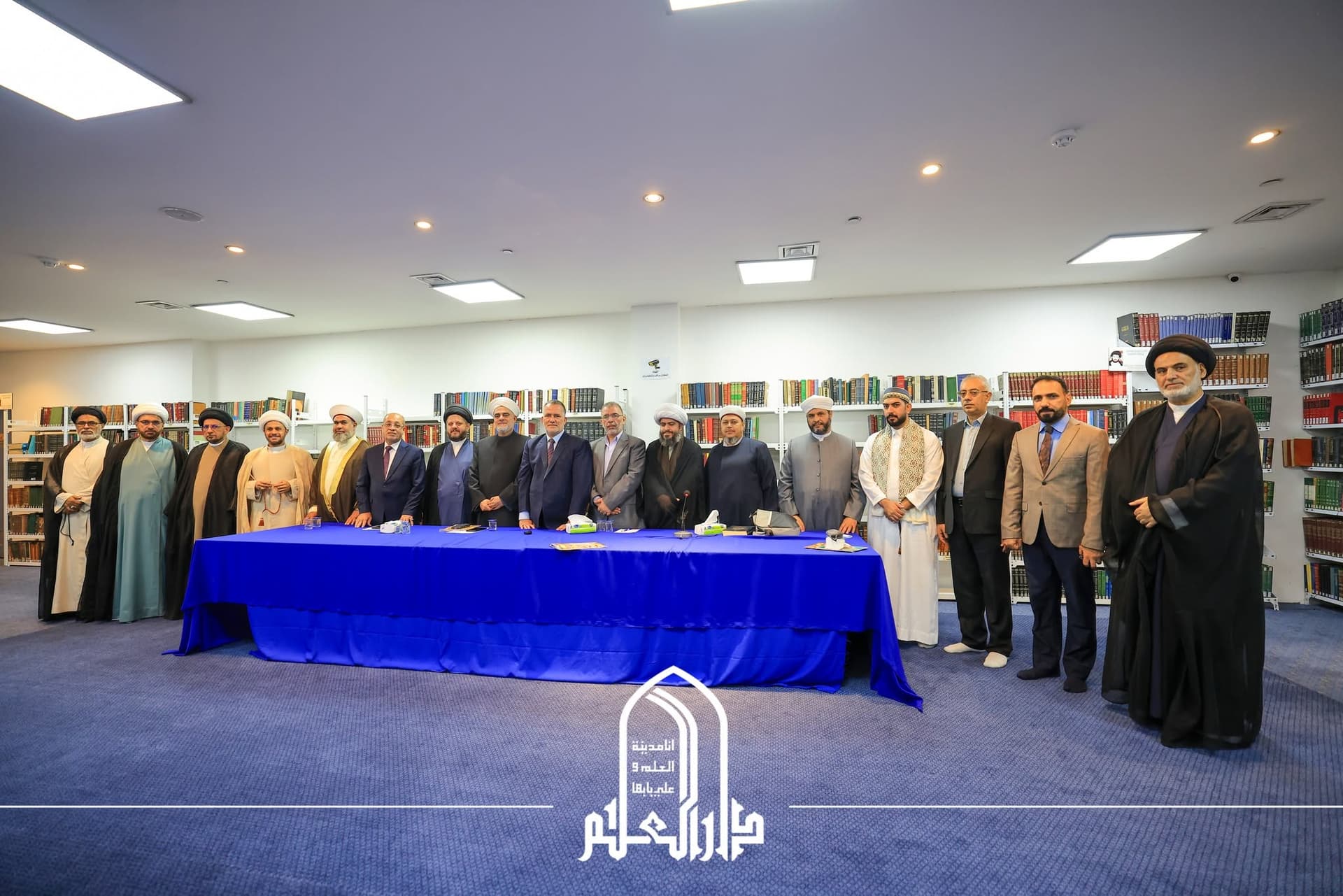
For decades, Dar al-'Ilm has played a significant educational and awareness-raising role through its scholarly publications, journals, and research centers, as well as by bringing together leading scholars and researchers. It was in this framework that the annual celebration commemorating the birth of the Prophet of Mercy, Muhammad, peace and blessings be upon him and his Family, and his grandson, Imam al-Sadiq, peace be upon him, was held. Organized by the al-Balaghi Center affiliated with Dar al-'Ilm on 29–30 August 2026 in the hall of the Imam al-Khoei Public Library, the event reaffirmed the institution's commitment to connecting religious occasions with serious scholarly activity.
One of the most notable features of the celebration was its inclusive character, which transcended sectarian boundaries and narrow affiliations. The organizers ensured that the invitation was open to all segments of Iraq's Muslim population, Sunni and Shi'a alike, and that the topics addressed matters of concern to Iraqis regardless of their affiliation. This approach reflects the vision upheld by Imam al-Khoei: that knowledge and religion should serve as bridges toward unity rather than causes of division.
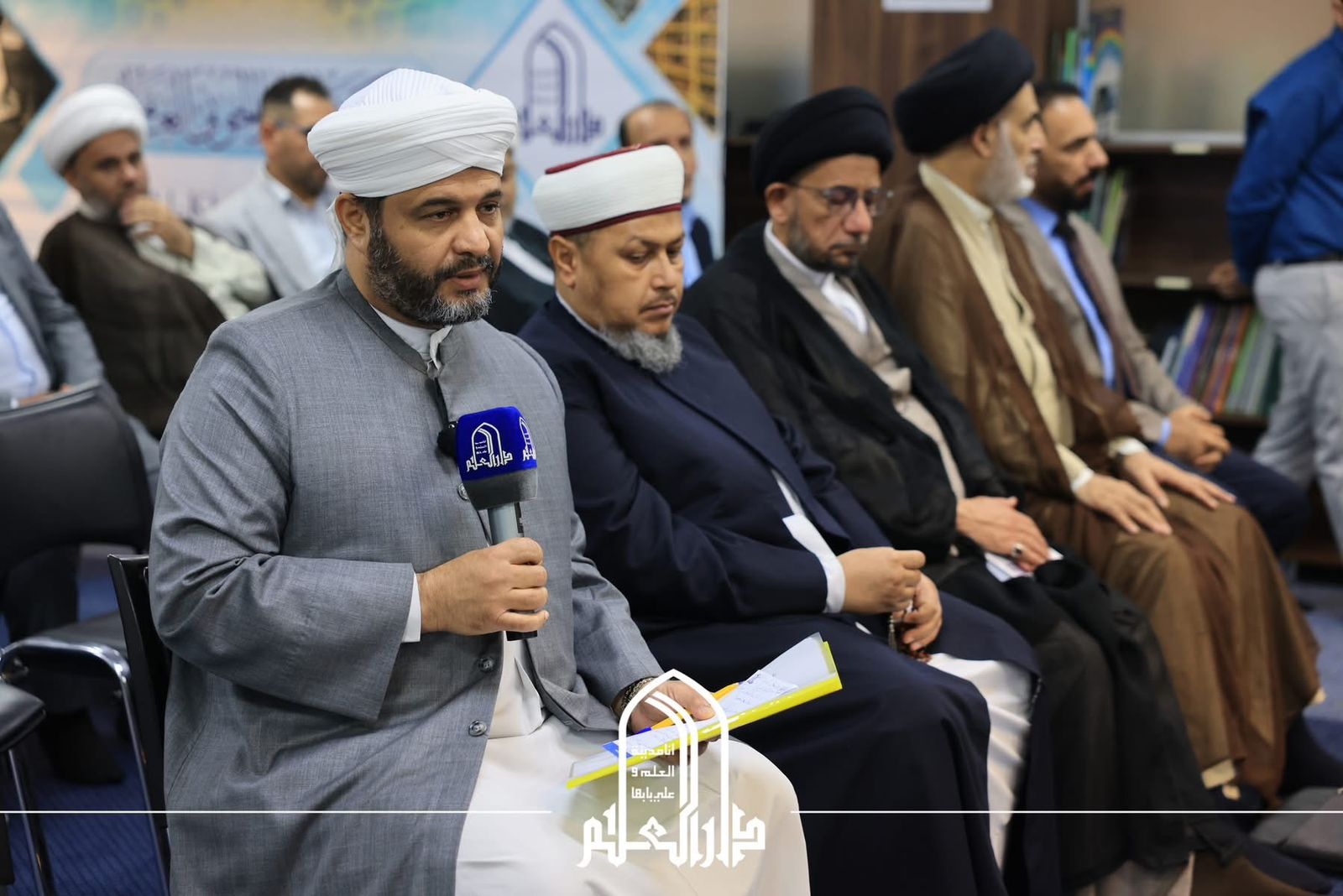
The library hall became a space for substantive dialogue, bringing together researchers, academics, and students of religious sciences from diverse intellectual and religious backgrounds. Three scholarly sessions examined the Prophetic tradition from several perspectives: historical, Orientalist, and narrative; followed by its social and human dimensions; and finally, the central role of Imam al-Sadiq in preserving the Prophetic hadith. This diversity of approaches demonstrates that Dar al-'Ilm is not content with a merely formal commemoration, but seeks to produce new knowledge that serves society and responds to its questions.
The efforts of the al-Balaghi Center in organizing this celebration offer a model for transforming religious occasions into substantive cultural projects. Rather than limiting the program to traditional preaching, the center presented a comprehensive scholarly forum involving university professors, religious scholars, and researchers. This gave the celebration a strong scholarly character and turned it into an intellectual event worthy of attention and documentation. The choice of Najaf al-Ashraf as the venue also gives the occasion symbolic significance. It is a city of knowledge and scholars, from which schools of jurisprudence and theology emerged that preserved the identity of the Muslim community.
The Participation of Sayyid Dr. Hashim al-Awadi
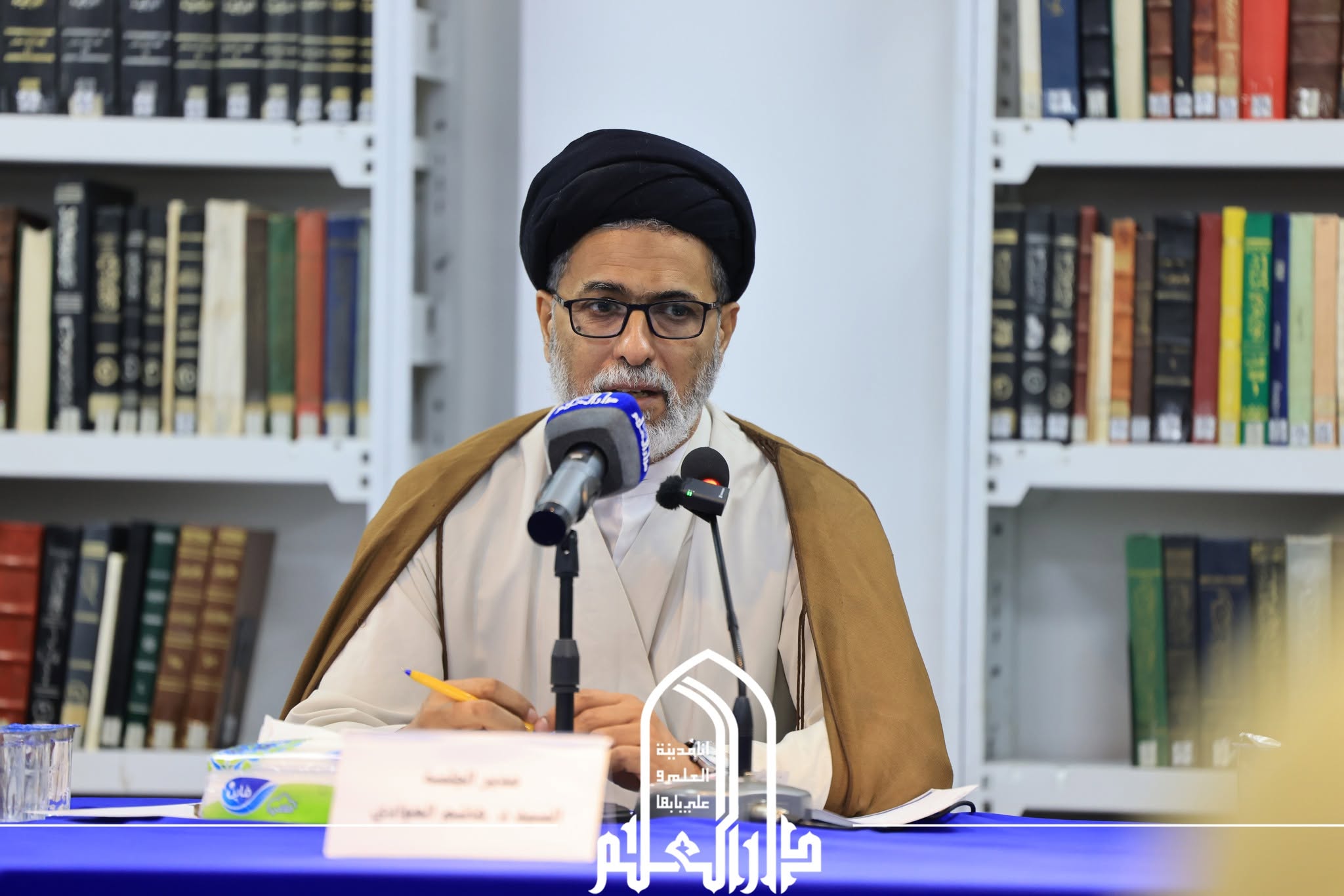
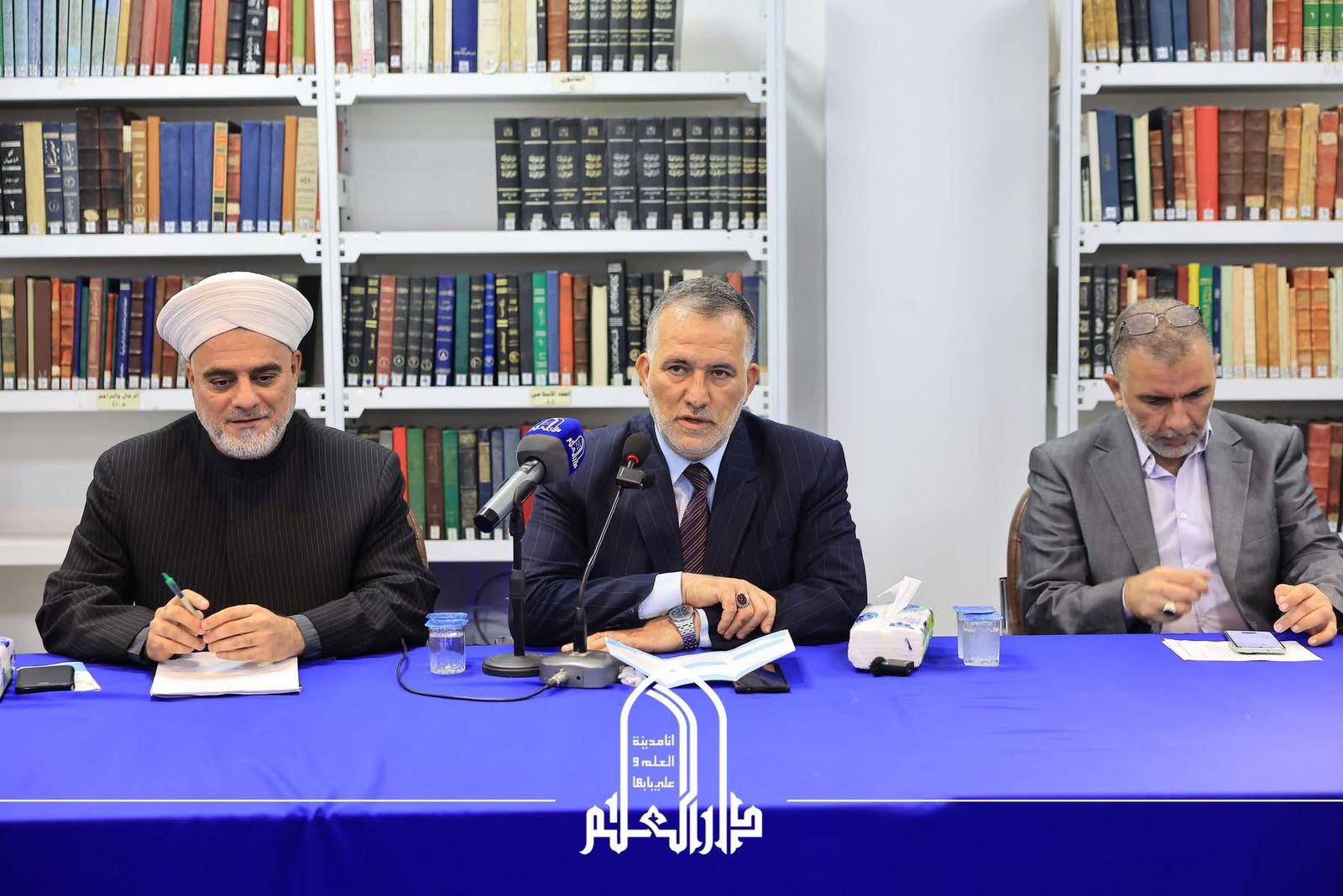
Among the most notable features of the scholarly celebration was the active participation of academic and intellectual figures representing the diversity of Iraqi society. In this regard, His Eminence Sayyid Dr. Hashim al-Awadi, Director of the Afrabia Center for Afro-Iraqi Elites, chaired the second scholarly session, entitled: “The Prophetic Tradition and the Building of Society – Approaches to Its Social and Human Dimensions.”
The session addressed one of the issues most closely connected to people's daily lives: how the Prophetic tradition established an integrated social system based on justice, mercy, and equality. The session brought together a group of researchers, including His Eminence Sheikh Dr. Omar Mahdi Saleh, member of the Association of Southern Scholars / Basra Governorate, who spoke on “The Prophetic Tradition and the Establishment of the Social System”; Professor of Sociology at the University of Kufa, Sayyid Dr. Muhaib al-Araji, who addressed “The Family in the Prophetic Perspective: Building and Protection”; and His Eminence Sayyid Haider Mahdi al-Hakim, who spoke on “Childhood in the Life of the Prophet: Care and Education.”
Dr. al-Awadi's moderation of the session was marked by professionalism and an ability to connect theoretical themes with contemporary Iraqi realities. In his interventions, he noted that the Prophetic tradition offers practical solutions to issues such as family disintegration, social injustice, and discrimination, and that drawing upon these models provides a path toward rebuilding Iraq's social fabric. He also addressed comparisons between the Islamic system and Western theories of social organization, stressing that commemorating the Prophet and Imam al-Sadiq, peace be upon them both, should translate into everyday conduct through respect for the rights of others, coexistence, and acceptance of diversity.
The presence of figures representing Iraq's scholarly and religious elites on such a distinguished intellectual platform sends a clear message: Iraq belongs to all its people, and loyalty to the nation and faith takes precedence over any narrower affiliation. It also reflects the Afrabia Center's growing ability to serve as an active voice within major scholarly and religious institutions and to contribute to the formulation of an inclusive religious, scholarly, and national discourse.
 The Importance of Commemorating Such Religious Occasions
The importance of commemorating the birth of the Noble Prophet and Imam al-Sadiq, peace be upon him, cannot be separated from the pressing need in Iraqi society today to restore the place of spiritual and moral values. Such celebrations are neither a luxury nor merely an annual tradition; they represent a civilizational necessity.
First: They connect younger generations to their history and identity, while offering them practical examples from the life of the Prophet and his Family that they can follow at a time when materialism has become dominant and social standards have changed.
Second: They provide a safe space for serious scholarly dialogue, away from discourses of excommunication and extremism.
Third: They reaffirm the unity of Iraqis across their diverse communities. Celebrating the Prophet Muhammad is a celebration of what unites the Muslim community, and no group can claim exclusive ownership of this great figure.
Fourth: They remind us that the original message of Islam was one of construction, development, and mercy, and that any departure from this principle constitutes a departure from the essence of the religion.
For this reason, the continued efforts of institutions such as Dar al-'Ilm of Imam al-Khoei, the al-Balaghi Center, and the Afrabia Center to commemorate these occasions through knowledge, intellectual engagement, and dialogue represent a genuine investment in Iraq's future. Nations are not built through slogans alone, but through knowledge, example, and a continual return to their authentic sources.
The closing of the sessions with the presentation of recommendations by His Eminence Sayyid Dr. Zaid Bahr al-Ulum, which emphasized the need to continue research into the Prophetic tradition and Islamic heritage and to draw upon them in addressing questions of thought and society, provides clear evidence that these celebrations seek to produce a tangible impact rather than merely mark a passing remembrance.
May this year's anniversary of the Prophet's birth serve as a new point of departure for us all: to make the Prophet's ethics a way of life, the knowledge of Imam al-Sadiq a path, and the unity of Iraq an objective from which we will never deviate.