The Afrabia Center for Afro-Arab Elites proceeds from a firm conviction that education is the foremost human and existential determinant of humanity.
Education is not merely the transmission of knowledge or the awarding of a university degree. It is the bridge that brings people together through mutual acquaintance, the space in which peoples exchange their knowledge and experiences, and the true guarantee for the continuity of the state and society.
Therefore, when armed conflicts target universities, libraries, and minds, they do not merely target buildings, but rather target *the very idea of the state, collective memory, and citizenship.
It is from this standpoint that this symposium emerges, as an attempt to read the crisis and to offer visions for safeguarding education as a human right and a necessity for survival.
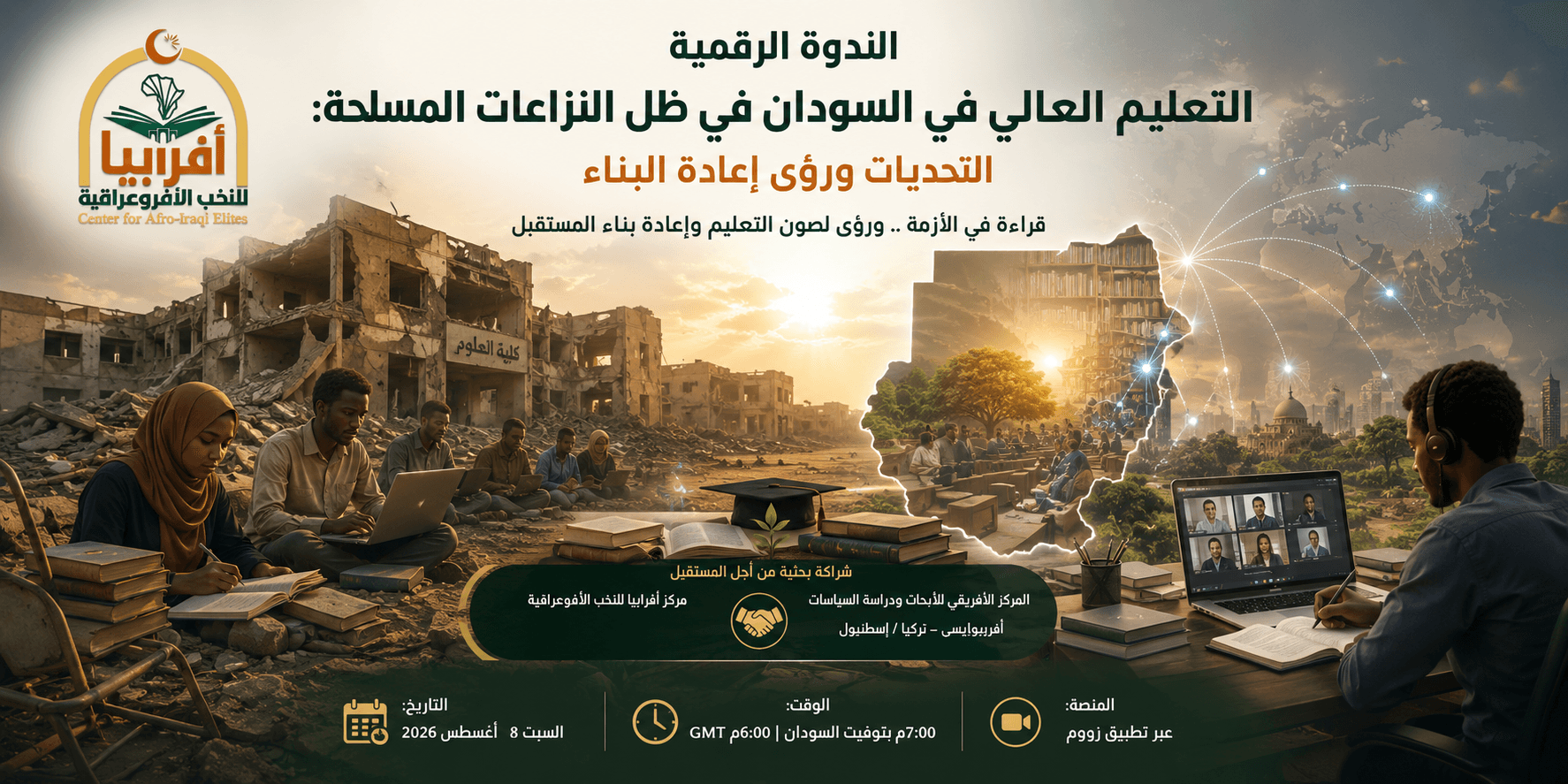
Accordingly, the symposium was organized by the Afrabia Center for Afro-Arab Elites in partnership with the African Center for Research and Policy Studies "AfroPolicy" – based in Turkey – Istanbul.
It focuses on knowledge production and supporting dialogue on issues of development, education, and identity in African and Arab countries.
Nature of the Partnership:
This symposium is organized by the Afrabia Center for Afro-Iraqi Elites in partnership with the African Center for Policy Studies (AfroPolisi), Türkiye, with the participation of specialized Sudanese researchers. It comes within the framework of a Sudanese–Iraqi–Turkish partnership aimed at leveraging shared research expertise to better understand the crises facing education in conflict-affected areas and to propose practical, implementable solutions.
Symposium Details:
Date: Saturday, August 8, 2026
Time: 7:00 PM Sudan time | 6:00 PM GMT
Platform: Via the Zoom application
Second: The Guests and Their Papers
The symposium hosts an elite group of Sudanese professors and researchers to discuss 5 main themes:
- Dr. Mohamed Saleh Omar
First Paper: The Human and Academic Crisis
Discusses the scale of destruction inflicted upon the human and academic infrastructure of Sudanese universities, through: the displacement of professors and students, brain drain, and the loss of academic records and psychological trauma.
Second Paper: Educational and Human Loss
Focuses on mechanisms for compensating educational loss, and means of re-supporting and integrating academically and psychologically displaced students, and addressing issues of degree equivalency.
- Dr. Ahmed Salah El-Din
Third Paper: Alternative Education and Academic Resilience
Reviews mechanisms of academic resilience in wartime, through distance education, the building of regional partnerships, and drawing on the experiences of countries comparable to Sudan as a model. - Dr. Abbas Al-Tijani Al-Tayeb
Fourth Paper: Visions and Mechanisms for Reconstruction
Presents practical proposals for the reconstruction of higher education, including funding sources, the role of regional and international organizations, and the rehabilitation of university infrastructure. - Speaker to be determined later
Fifth Paper: Beyond the State – Education Financing Policies and Institutional Legitimacy
Discusses the political dimension of education in wartime: the freezing of budgets as a political weapon, the legitimacy of university administration from exile, the role of alternative organizations, and the recognition of degrees as an instrument of sovereignty.
The Central Question: Who owns the decision over education when the state collapses?
Third: The Future of Education in Countries of Conflict and War
- From Physical Destruction to the Targeting of the Mind
War is no longer confined to the bombing of buildings, but has extended to targeting memory: the burning of libraries, the looting of museums, and the loss of documents. Reconstruction begins with the restoration of the state's "academic identity." - A New Legitimacy for Education
In the absence of the state, new models emerge: universities in exile, digital platforms, and partnerships with organizations. How can we ensure international recognition of these without compromising the sovereignty of the state? - Education as an Instrument of Resilience
The experiences of Syria, Yemen, and Iraq have demonstrated that distance education and regional partnerships preserve the continuity of generations. The future of education will be "hybrid": limited in-person attendance + digitization + regional recognition. - Reconstruction Begins with the Human Being
Before bricks and cement, the professor and the student must be rehabilitated. Investment in psychological support, emergency scholarships, and programs for the integration of the displaced is the cornerstone.
In conclusion, the symposium does not aim merely to diagnose the crisis, but to set a "compass" for the post-war period. For education is not only a victim of conflicts, but also the key to emerging from them and building a more resilient state, because through it peoples come to know one another, exchange knowledge, and build the future.