The project to launch the single currency "ECO" represents one of the most prominent pillars of the economic and monetary integration agenda in West Africa, embodying a strategic ambition that the Economic Community of West African States (ECOWAS) has pursued since it’s founding: the establishment of a monetary union capable of deepening economic integration and reducing dependence on foreign currencies. The idea of a single currency has been linked to the objectives of the 1975 Treaty of Lagos, which established ECOWAS, and was later reaffirmed in the 1993 Revised ECOWAS Treaty as one of the principal instruments for achieving a common market and an economic union. Despite nearly five decades having passed since the project was first proposed, its implementation has continued to face a series of delays and political, economic, and institutional challenges, making it a genuine test of West Africa's capacity to move from theoretical integration to practical integration. At the sixty-ninth ordinary session of the ECOWAS Authority of Heads of State and Government, held in Abuja, Nigeria, in June 2026, the Authority reaffirmed its commitment to launching the single currency in 2027, while adopting a phased approach that allows countries meeting the economic convergence criteria to join first, with the remaining countries following successively once they fulfil the necessary technical and economic requirements — a shift that reflects a more realistic approach compared with previous plans for a collective, simultaneous launch.
The philosophy underlying the ECO project rests on addressing the imbalances created by the persistence of monetary fragmentation in West Africa, where the region continues to rely on two principal monetary systems: the first is the CFA Franc, used within the West African Economic and Monetary Union (UEMOA), which comprises eight countries and is pegged to the euro through special monetary arrangements; the second comprises the independent national currencies used in the remaining ECOWAS member states, foremost among them Nigeria, Ghana, Sierra Leone, The Gambia, Liberia, Guinea, and Cabo Verde. This monetary plurality has resulted in higher transfer costs, increased exchange-rate volatility risks, and inefficient cross-border payment systems, alongside the continued weakness of intra-regional trade, which still represents a limited share of West Africa's total trade compared with other regional economic groupings. From this perspective, the ECO is viewed as a tool for boosting regional trade and investment, facilitating capital movement, reducing the cost of commercial transactions, and lessening reliance on the dollar and the euro in financial settlements, in addition to building a more coordinated monetary policy that grants the region greater negotiating weight within the global economy. International institutions, including the World Economic Forum, likewise consider that the success of the monetary union could contribute to enhancing financial stability and increasing the region's capacity to mobilize the financing required for economic transformation and for addressing development and climate-change challenges.
Although the project originally targets all ECOWAS member states, the regional environment has, since 2024, witnessed significant political shifts represented by the withdrawal of Mali, Burkina Faso, and Niger from the organization and their formation of the Alliance of Sahel States. This has created a new reality for the single-currency project, whether in terms of the number of countries targeted, the size of the common market, or future monetary-coordination mechanisms. Nevertheless, ECOWAS affirmed in its recent meetings that these developments will not lead to the abandonment of the ECO project, but rather require a redesign of implementation mechanisms suited to the new institutional environment, while keeping the door open to any future arrangements that would allow the scope of the monetary union to be expanded, should appropriate political and economic conditions arise.
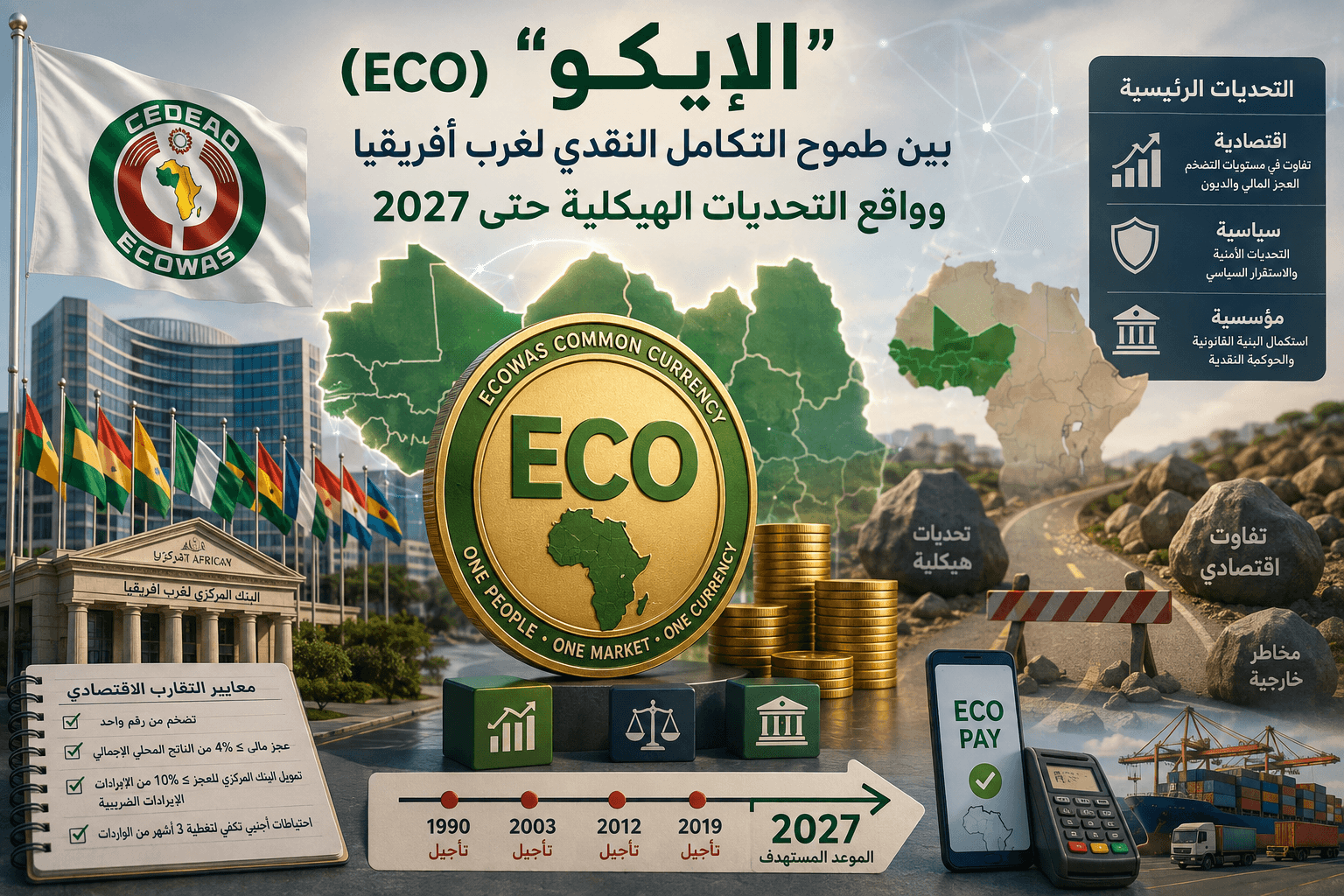
The project's institutional framework is built upon the ECOWAS Monetary Cooperation Programme, which has established a set of economic convergence criteria as a fundamental condition for joining the monetary union. These criteria are divided into four primary criteria and six secondary criteria. The primary criteria include achieving a single-digit inflation rate by the end of each year; a fiscal deficit not exceeding 4 percent of GDP; central-bank financing of the government deficit not exceeding 10 percent of the previous year's tax revenue; and holding foreign-exchange reserves sufficient to cover at least three months of imports. The secondary criteria include non-accumulation of new domestic debt arrears; raising tax revenue to no less than 20 percent of GDP; ensuring the wage bill does not exceed 35 percent of tax revenue; ensuring public investment is no less than 20 percent of tax revenue; as well as maintaining real exchange-rate stability and achieving a positive real interest rate. Reports issued by the West African Monetary Institute (WAMI) over the past several years have shown that only a limited number of countries have managed to meet all the criteria simultaneously, a fact that reflects the persistent structural gap among the region's economies and explains a substantial part of the project's repeated postponements.
Despite this technical framework, the history of the ECO project has been one of successive delays. Since the adoption of the first roadmap for the monetary union, the launch date has been postponed more than once owing to the difficulty a large number of countries faced in meeting the convergence criteria, the persistent divergence in economic performance, and delays in completing the shared monetary institutions. Following the official adoption of the name "ECO" at the 2019 ECOWAS summit, hopes rose that the currency would be launched within a few years; however, the COVID-19 pandemic and the ensuing global economic disruptions, followed by the fallout from the Russia–Ukraine war and the accompanying surge in inflation and in food and energy prices, together led to yet another postponement of the project. The year 2027 now stands as the fifth target date set for launching the single currency, though this time ECOWAS has moved away from the idea of a collective launch toward a more flexible approach based on phased implementation, whereby the first phase begins with the countries that achieve the convergence criteria, while support continues for the remaining countries to reach full readiness — reflecting a growing recognition of the difficulty of waiting for all members to fulfil the conditions at the same time.
In this context, the Director-General of the West African Monetary Agency (WAMA), Boubacar Camara, affirmed during the technical and ministerial meetings held in Monrovia during 2026 that the path toward launching the ECO has become institutionally clearer, but that it still requires "urgent collective action" to ensure adherence to the roadmap. He explained that the period remaining until 2027 must witness an acceleration in the implementation of fiscal and monetary reforms, strengthened coordination among central banks, and the completion of the legal and regulatory frameworks for the monetary union, considering that meeting the launch date "represents a major challenge, but not an impossible one," provided that member states commit to the required reforms.
In parallel, the ECOWAS Commission, together with the Monetary Agency and the West African Monetary Institute (WAMI), intensified their technical meetings to review progress achieved in implementing the Monetary Cooperation Programme. Recent reports showed relative improvement in the performance of certain economies, particularly with respect to declining inflation rates in a number of countries, improved foreign-reserve levels, and a reduction in the ratio of public debt to GDP in some economies. Progress nonetheless remained uneven among member states, leaving full convergence a goal yet to be achieved.
The recent summit meetings also witnessed an important shift in the approach to the project, in that priority is no longer placed solely on meeting a fixed timeline, but rather on ensuring the launch of a monetary union possessing a sufficient degree of stability and sustainability. The Authority accordingly adopted the principle of "convergence first, then expansion," allowing qualifying countries to form the initial core of the monetary union, while establishing clear mechanisms for other countries to join in subsequent stages once they meet the criteria. This shift is regarded as one of the most significant institutional developments the project has undergone since its inception, as it reduces the likelihood of the currency being postponed again on account of a limited number of countries falling behind.
At the same time, the completion of the monetary union's institutional architecture remains one of the greatest challenges. As of mid-2026, consultations continued on a number of fundamental files, foremost among them completing the legal arrangements for the Central Bank of West Africa, its decision-making mechanisms, its capital structure, and the system for distributing voting rights among member states, in addition to the mechanisms for managing foreign reserves and unified monetary policy. This file carries particular importance given the considerable disparity among the region's economies, as the larger economies — Nigeria foremost among them — seek to ensure a governance system that reflects their economic weight, while the smaller states insist on the need to preserve the principle of balanced representation within shared institutions.
Among the other notable developments is the continued work to protect the new currency's legal and commercial identity. The Authority of Heads of State and Government welcomed the completion of procedures to register the name "ECO" with the African Intellectual Property Organization, and instructed the ECOWAS Commission to continue efforts to protect the trademark at both the regional and international levels, so as to prevent the name's use in any other projects or products and to strengthen the currency's legal and institutional readiness ahead of its launch.
On the economic front, ECOWAS has come to view the ECO project as part of a broader vision for regional integration, rather than as a stand-alone monetary undertaking. Economic reports issued by the Commission during 2025 and 2026 have linked the success of the single currency to the implementation of the African Continental Free Trade Area (AfCFTA), the development of regional payment systems, the strengthening of industrial and agricultural value chains, and the acceleration of digital transformation — making the monetary union one of the supporting tools for building a more integrated and competitive regional market, rather than an end in itself.
The principal challenges facing the ECO project can be identified across three interlocking dimensions — economic, political, and institutional — challenges that relate not only to the readiness of the new currency, but to West Africa's capacity to manage a monetary union encompassing economies that differ markedly in size, level of development, and production structures. At the economic level, the region continues to exhibit a clear structural divergence between the larger economies — foremost among them Nigeria, Ghana, and Côte d'Ivoire — and the smaller, more fragile economies, whether in terms of growth rates, inflation, levels of public debt, or governments' capacity to mobilize domestic revenue. This disparity is compounded by the fact that most of the region's economies rely on the export of primary commodities, making them more vulnerable to global price fluctuations and external shocks, which complicates the task of unifying monetary policy given the differing priorities and needs of each economy.
Inflation rates likewise remain one of the greatest obstacles to achieving economic convergence, as several countries in the region experienced high inflation in recent years as a result of global supply-chain disruptions, rising food and energy prices, and the depreciation of national currencies. Despite the relative improvement recorded by several countries during 2026, the gap between member economies persists, limiting the ability of all countries to simultaneously meet the required monetary and fiscal criteria. In this context, a number of economists and private-sector leaders have warned that launching a single currency in the absence of genuine economic convergence could transfer imbalances from the weaker economies to the larger ones, rather than achieving the intended stability.
Nigeria stands out as the most sensitive link in the project, not only because it represents the largest economy in West Africa, but because it accounts for the greatest share of the region's GDP and population. Abuja has therefore continued to insist that the ECO's success requires the establishment of strong monetary institutions and clear mechanisms for sharing responsibilities, so as to ensure that the stronger economies are not burdened with the fiscal imbalances of other countries, and that the Central Bank of Nigeria's ability to respond to domestic economic shocks is not undermined. Conversely, the smaller states consider that the success of the monetary union requires a degree of financial and economic solidarity that would allow the development gaps between union members to be narrowed.
At the political level, the regional environment has undergone profound transformations in recent years that have had a direct bearing on the ECO project. The escalation of security crises in the Sahel region and the Lake Chad Basin, and the continued activity of armed groups, have increased pressure on member states' public budgets, at a time when these challenges have coincided with a series of political changes and military coups in Mali, Burkina Faso, and Niger, which culminated in these countries' withdrawal from ECOWAS and the establishment of the Alliance of Sahel States (AES). This development has imposed a new reality on the monetary-union project, requiring the organization to reassess its plans in light of the region's changing political map, while at the same time preserving the momentum of the economic-integration project.
Although the three withdrawing countries continue to use the CFA Franc within the West African Economic and Monetary Union (UEMOA), their continued distancing from ECOWAS institutions raises questions about the future of monetary and regional coordination over the long term, and further complicates any future plans to integrate all West African economies within a single monetary union. ECOWAS, for its part, affirms that the ECO project will continue according to the approved roadmap, while leaving the door open to any future arrangements that would allow the union's scope to be expanded should political circumstances change.
An additional external factor of no less importance is the historical legacy of the CFA Franc and the monetary relationship with France. Despite the reforms the CFA Franc system has undergone in recent years, debate continues within West Africa's political and economic circles regarding the future of the peg to the euro, the mechanisms for managing foreign reserves, and the true level of independence of monetary policy. The region's major economic powers, foremost among them Nigeria and Ghana, therefore insist that the new currency should be managed entirely through independent African institutions, in a manner that reinforces monetary sovereignty and ensures that the monetary union is not subject to any external arrangements.
At the institutional level, the project continues to face challenges related to the mechanism for transitioning to the single currency. While debate in previous years centred on the choice between launching the ECO through the West African Monetary Zone (WAMZ) countries first, or converting the CFA Franc into the ECO before extending it to the remaining countries, current discussions focus increasingly on the phased-launch model approved at the most recent ECOWAS summit. This model is based on forming an initial core of countries that meet the convergence criteria, while the remaining countries continue implementing economic reforms until they fulfil the requirements for accession. This option is regarded as more realistic than previous models, as it balances preserving the project's credibility with avoiding its indefinite postponement.
The institutions responsible for the project also face the challenge of completing the monetary union's legal and regulatory architecture, including the adoption of unified legislation, the establishment of payment and financial-settlement systems, the development of banking-supervision and financial-oversight mechanisms, and the strengthening of coordination among national central banks. The success of any monetary union depends not merely on the issuance of a new currency, but also on the existence of institutions capable of managing monetary policy, handling financial crises, and preserving the stability of the banking system across the various member states — files that still require intensive technical and institutional work before 2027 arrives.
Despite these challenges, the regional economic indicators for 2025 and 2026 reflect a degree of improvement compared with previous years, which has bolstered cautious optimism regarding the possibility of progress in the monetary-union project. Economic forecasts issued by the ECOWAS Commission point to a continued decline in inflation rates across a number of member economies, improved foreign-reserve levels, and a reduction in the ratio of public debt to GDP in some countries, alongside a widening current-account surplus in several primary-commodity-exporting economies — although the fiscal deficit remains one of the most prominent challenges to achieving full convergence. ECOWAS's monetary institutions have likewise continued to periodically review convergence indicators, while providing technical support to countries still facing difficulties in meeting the criteria, reflecting the project's gradual transition from the planning stage to the stage of institutional and operational preparation.
In the same vein, ECOWAS has devoted growing attention to the legal and regulatory aspects associated with the new currency, having completed the procedures for registering the name "ECO" with the African Intellectual Property Organization, and continuing efforts to secure legal protection for the name at both the regional and international levels, in a step aimed at reinforcing the currency's institutional identity ahead of its launch. The ECOWAS Commission, the West African Monetary Agency (WAMA), and the West African Monetary Institute (WAMI) likewise intensified their technical meetings during 2026 to follow up on the implementation of the roadmap, review member states' level of readiness, and complete the legal and regulatory frameworks for the Central Bank of West Africa, the mechanisms for managing monetary policy, and the regional payment system — elements considered fundamental requirements for the success of any sustainable monetary union.
At the same time, the ECO project has become part of a broader vision for regional economic integration that extends beyond the mere issuance of a single currency to the building of a more interconnected regional market. The Commission has come to link the success of the ECO with strengthening intra-regional trade, developing cross-border digital payment systems, supporting the implementation of the African Continental Free Trade Area, improving the investment environment, and strengthening regional value chains — thereby enabling West African countries to increase their competitiveness and reduce their dependence on external markets. From this standpoint, the project's success is no longer measured solely by the date of the currency's issuance, but by its capacity to contribute to building a more integrated and sustainable economic system.
Nevertheless, 2027 remains a pivotal milestone in the project's history. ECOWAS's adoption of the phased-launch approach reflects a strategic shift in the management of the monetary union, one that gives priority to the quality and sustainability of implementation rather than to a collective launch that may not yet have all the necessary economic and institutional foundations in place. This approach allows the countries that have met the convergence criteria to form the initial core of the monetary union, while continuing to provide technical and economic support to the other countries until they become eligible to join in subsequent stages — a course that may help strengthen the project's credibility and reduce the risks of continued postponement.
At the same time, a number of variables remain that could affect the announced timeline, including the persistence of security challenges in West Africa and the Sahel region, the divergence in levels of fiscal discipline among member states, the changes that have occurred in the regional structure following the withdrawal of Mali, Burkina Faso, and Niger from ECOWAS, as well as the need to complete the shared monetary institutions and strengthen political consensus around governance and decision-making mechanisms within the prospective central bank. The project's success will therefore remain contingent on member states' ability to reconcile political and economic considerations, and to translate political will into practical, implementable reforms.
In conclusion, the ECO cannot be viewed merely as a project to issue a new currency; rather, it represents one of the most ambitious African integration projects since the founding of ECOWAS. It reflects West African countries' pursuit of a more integrated economic space, the strengthening of their monetary independence, and the reinforcement of their capacity to withstand global economic fluctuations. Should the organization succeed in launching the currency according to the approved phased approach, while ensuring the stability of monetary institutions and member states' adherence to the convergence criteria, this could mark a historic turning point in the trajectory of African economic integration, offering West Africa a practical model for building a monetary union grounded in realism and gradualism. If, however, the reforms falter or implementation is postponed once again, the project will face a challenge concerning the preservation of its credibility that outweighs any concern tied to the launch date itself. The ECO project, through to 2027, thus remains a mirror reflecting, at once, both the ambitions and the limits of African economic unity, as well as the region's capacity to translate strategic visions into functioning institutions and shared economic policies capable of achieving development and stability over the long term.