
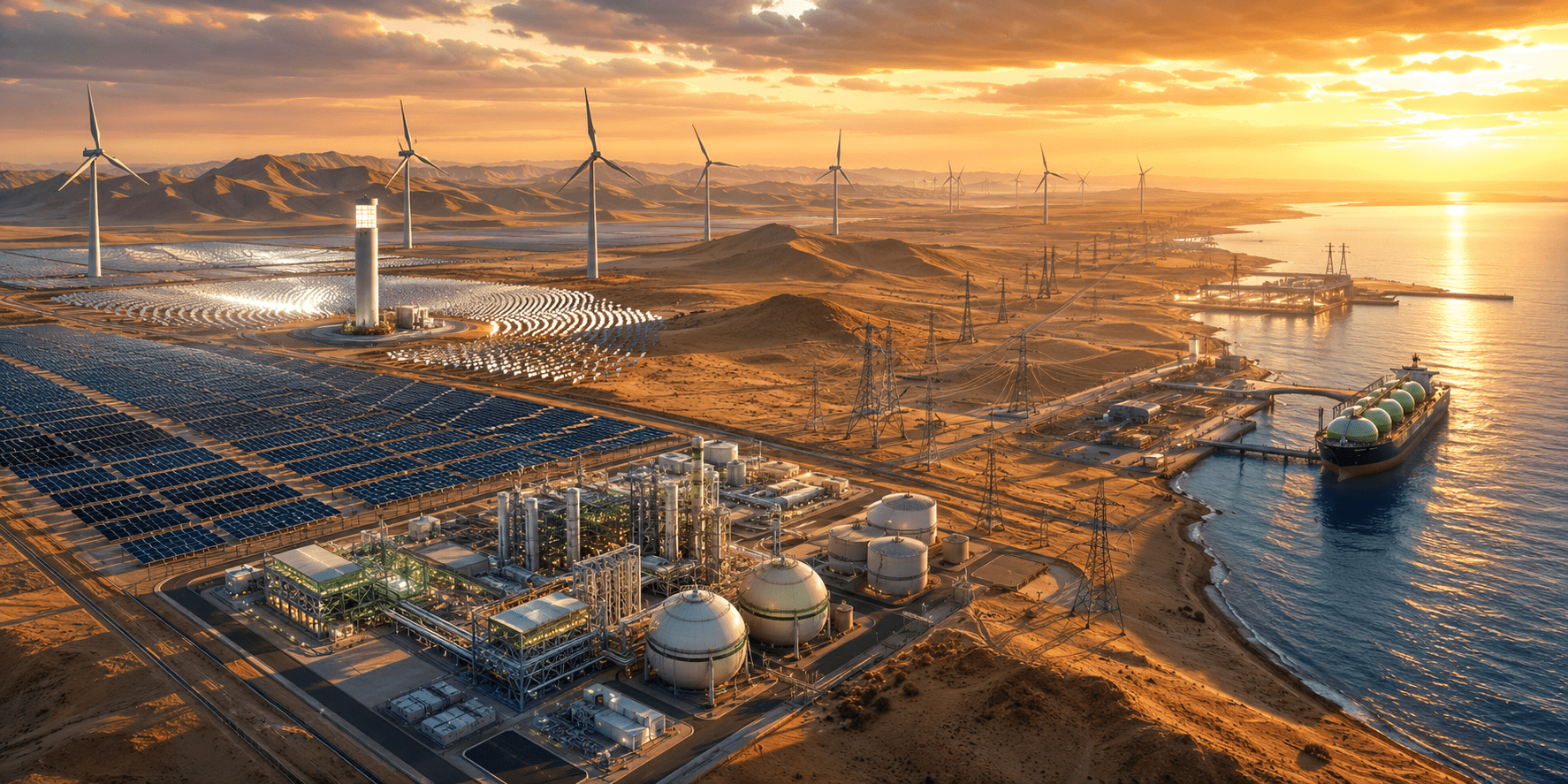
The accelerating global energy transition, driven by climate change mitigation efforts and the pursuit of carbon neutrality, has fundamentally reshaped perceptions of Africa's vast desert landscapes. Rather than being viewed merely as sparsely populated arid regions, the Sahara and other African deserts are increasingly recognized as strategic assets capable of supporting a new low-carbon energy economy.
Covering approximately 9.2 million square kilometers, the Sahara receives annual solar irradiation ranging from 2,000 to 2,800 kWh per square meter, placing it among the most solar-rich regions on Earth. According to estimates associated with the DESERTEC concept, the solar energy reaching the Sahara over only a few hours theoretically exceeds humanity's annual energy consumption, illustrating the extraordinary renewable energy potential of the region.
This growing recognition has encouraged governments, investors, and international organizations to reconsider Africa's role within the global energy system. Rather than remaining primarily an exporter of conventional raw materials, several African countries are positioning themselves as future producers of renewable electricity, green hydrogen, and other low-carbon energy carriers.
This article examines the scientific foundations of this transformation, reviews the evolution of the DESERTEC initiative, analyzes the experiences of Morocco, Mauritania, and Namibia, and discusses the geopolitical and economic challenges that will shape Africa's position within the emerging global hydrogen economy.
1. Why the African Desert?
Africa's deserts possess a unique combination of geographical and environmental characteristics that make them exceptionally suitable for large-scale renewable energy development.
The first comparative advantage lies in exceptionally high direct solar irradiation. These conditions significantly improve the efficiency of both Concentrated Solar Power (CSP) and Photovoltaic (PV) technologies while reducing long-term electricity generation costs.
A second advantage is the availability of vast expanses of relatively unused land. Low population density and limited agricultural activity across large desert areas reduce land-use conflicts and facilitate the deployment of utility-scale renewable energy projects.
Geography provides a third strategic advantage. At its narrowest point, the Strait of Gibraltar separates North Africa from Southern Europe by only approximately 14 kilometers, creating favorable conditions for future electricity transmission through High Voltage Direct Current (HVDC) interconnections.
Studies conducted by the German Aerospace Center (DLR) have concluded that harnessing North Africa's solar resources could simultaneously strengthen regional energy security, reduce greenhouse gas emissions, and deepen Euro-African energy cooperation, provided that sufficient investment, infrastructure, and regulatory frameworks are established.
2. DESERTEC: A Vision Ahead of Its Time
The DESERTEC initiative was formally launched in 2009 by the Desertec Foundation with the objective of promoting climate protection, energy security, and sustainable development through the large-scale utilization of renewable energy resources located in desert regions.
Its central concept envisioned extensive solar power plants—primarily based on Concentrated Solar Power (CSP) technology—supplying electricity to North Africa, the Middle East, and Europe through an integrated HVDC transmission network. Early feasibility assessments estimated total investment requirements at approximately €400 billion.
Despite attracting considerable international attention, the initiative faced several structural obstacles that prevented its implementation on the originally envisioned scale.
During the early 2010s, CSP technology remained substantially more expensive than conventional fossil-fuel generation. At the same time, the rapid decline in photovoltaic costs fundamentally altered global investment priorities, making utility-scale PV projects considerably more competitive than large CSP facilities.
Additional challenges included political instability across parts of North Africa, the technical difficulties associated with operating solar facilities in harsh desert environments, sand accumulation on mirrors, and the significant water requirements needed for maintenance and cooling.
Although DESERTEC never evolved into the transcontinental electricity network initially envisioned, its strategic importance should not be underestimated. The initiative fundamentally transformed international discussions regarding Africa's renewable energy potential and established the conceptual foundation for today's growing interest in large-scale green hydrogen production across the continent.
3. Morocco: From Renewable Power Generation to Industrial Transformation
Morocco has emerged as one of Africa's leading renewable energy pioneers by adopting a long-term strategy aimed at reducing dependence on imported fossil fuels while strengthening domestic energy security. Within this strategy, the Noor Ouarzazate Solar Complex has become one of the country's flagship infrastructure projects and one of the world's largest concentrated solar power developments.
With a total installed capacity of 580 MW, the complex combines Concentrated Solar Power (CSP) technologies with molten salt thermal storage, allowing electricity generation to continue several hours after sunset. This storage capability addresses one of the principal limitations of conventional solar generation by improving supply reliability during peak demand periods.
Beyond electricity production, Noor Ouarzazate illustrates how renewable energy projects can stimulate technological development, attract international financing, and contribute to national climate objectives. The project is expected to reduce carbon dioxide emissions by approximately 3.7 million tonnes annually while displacing around one million tonnes of oil equivalent each year.
Its implementation relied upon a broad international financial partnership involving the World Bank, the African Development Bank, the European Investment Bank, and Germany's KfW Development Bank, making it an important reference for large-scale renewable energy financing across emerging economies.
More importantly, Morocco's experience demonstrates that renewable energy policy extends beyond electricity generation. It increasingly serves as an industrial strategy designed to support manufacturing, enhance technological capabilities, and position the country as a future exporter of clean energy products.
4. Green Hydrogen: A New Phase of Africa's Energy Transition
As renewable electricity costs have continued to decline and electrolysis technologies have matured, international attention has gradually shifted from exporting electricity toward producing green hydrogen and its derivatives, particularly green ammonia.
Unlike electricity, hydrogen can be transported over long distances and used in sectors where direct electrification remains technically difficult, including heavy industry, maritime transport, steel manufacturing, and fertilizer production. Consequently, countries with abundant renewable resources are increasingly viewed as potential suppliers of future global hydrogen markets.
1. Mauritania: An Emerging Green Hydrogen Hub
Mauritania has rapidly positioned itself among Africa's most promising destinations for green hydrogen investment. Exceptional wind resources along the Atlantic coast, combined with abundant solar irradiation across its desert interior, provide one of the world's most favorable renewable energy profiles.
In December 2025, the Mauritanian government announced a national objective of producing 12.5 million tonnes of green hydrogen annually by 2035, accompanied by the adoption of a dedicated hydrogen regulatory framework and the establishment of specialized national institutions responsible for sector governance.
Among the country's flagship developments is the AMAN Project, designed to deploy approximately 30 GW of renewable generation capacity capable of producing around 1.7 million tonnes of green hydrogen or nearly 10 million tonnes of green ammonia each year, according to current project plans.
Another strategic initiative, the Nour Project near Nouadhibou, seeks to develop approximately 10 GW of renewable capacity while creating export corridors linking Mauritania with European markets through partnerships that include the Port of Rotterdam.
Collectively, announced renewable energy projects exceed 100 GW of planned capacity, highlighting both Mauritania's exceptional resource potential and the growing international interest in its emerging hydrogen economy.
2. Namibia: Southern Africa's Hydrogen Gateway
Namibia has adopted a similarly ambitious strategy centered on transforming its renewable resources into a competitive green hydrogen industry. Supported by the European Union's Global Gateway Initiative, the country has launched several large-scale projects intended to establish a regional hydrogen production hub.
Current plans include renewable electricity facilities supplying electrolysers powered by approximately 85 MW of solar capacity during initial development phases. Broader investment proposals, estimated at nearly US$10 billion, are expected to generate approximately 15,000 construction jobs and around 3,000 permanent positions once commercial operations begin.
Although many projects remain under development, Namibia's strategy illustrates how green hydrogen may become a catalyst for broader industrial diversification rather than merely another export commodity.
3. Morocco: Expanding into Green Ammonia
Morocco's renewable energy strategy increasingly emphasizes downstream industrial applications. Among the country's most significant initiatives is the HEVO Ammonia Project, which aims to produce approximately 183,000 tonnes of green ammonia annually.
Once operational, the project could supply roughly 10% of Morocco's domestic fertilizer feedstock requirements, reducing dependence on imported natural gas while strengthening the country's fertilizer industry.
Morocco also participates in the Africa Green Hydrogen Alliance, alongside Egypt, Kenya, Mauritania, Namibia, and South Africa. The alliance seeks to coordinate investment policies, accelerate technology deployment, and position Africa as a globally competitive producer of renewable hydrogen.
More than forty hydrogen-related projects have already been announced across participating countries, demonstrating the continent's growing role within the emerging international hydrogen economy.
5. Europe: Importing Renewable Energy, Not Sunlight
Europe's accelerating decarbonization agenda has significantly increased interest in renewable energy partnerships with African countries. Rather than importing sunlight itself, European markets seek access to electricity, green hydrogen, and green ammonia produced from Africa's abundant renewable resources.
Germany has taken a leading role by establishing energy partnerships with countries such as Morocco and Mauritania to support hydrogen production and secure future supplies for hard-to-abate sectors, including heavy industry and chemical manufacturing. These initiatives complement broader European strategies under the European Green Deal and REPowerEU, both of which emphasize diversification of clean energy sources and reduced dependence on fossil fuel imports.
Nevertheless, African policymakers and researchers increasingly stress that the continent should not become merely a supplier of renewable energy commodities. Instead, the objective should be to develop domestic industrial ecosystems capable of transforming renewable electricity into higher-value products, including green steel, fertilizers, synthetic fuels, and other energy-intensive manufactured goods.
This perspective reflects a broader debate concerning Africa's role within the global low-carbon economy. Future cooperation will be judged not only by export volumes but also by its contribution to technology transfer, industrialization, employment, and long-term economic transformation.
6. Key Challenges
Despite its exceptional renewable energy potential, Africa's transition toward a large-scale green hydrogen economy faces several structural challenges.
The first concerns infrastructure. Developing competitive hydrogen value chains requires substantial investment in renewable generation, transmission networks, desalination facilities, storage systems, export terminals, and port infrastructure. Such investments demand sustained international financing alongside strong domestic planning.
A second challenge involves governance and regulatory stability. Investors require transparent legal frameworks governing land use, licensing procedures, environmental standards, and long-term contractual arrangements. Institutional capacity therefore remains a critical determinant of project viability.
Water availability represents another important constraint. Electrolysis depends on reliable water supplies, while many proposed hydrogen projects are located in arid regions. Consequently, integrating renewable-powered desalination facilities into future hydrogen developments has become an essential component of project design.
Finally, the question of economic value creation remains central. Renewable energy investments will contribute more effectively to sustainable development if they generate local employment, strengthen industrial capabilities, encourage technological learning, and expand domestic manufacturing rather than simply exporting raw energy carriers.
Africa's deserts are increasingly being recognized as strategic assets within the global energy transition. Their exceptional solar and wind resources, combined with rapid technological progress and growing international investment, provide a unique opportunity to position the continent as a major producer of renewable electricity and green hydrogen.
Although the original DESERTEC initiative was never implemented as envisioned, it fundamentally reshaped international thinking by demonstrating that North Africa's renewable resources could contribute to regional and global energy security. Today, projects underway in Morocco, Mauritania, and Namibia indicate that this vision has evolved beyond long-distance electricity transmission toward the production of globally tradable clean fuels.
The long-term success of this transformation, however, will depend on more than natural resource abundance. It will require effective institutions, stable regulatory environments, modern infrastructure, and policies capable of ensuring that renewable energy investment supports industrial development, technological innovation, and inclusive economic growth.
If these conditions are met, Africa's deserts may become not merely suppliers of clean energy, but foundations of a new industrial geography in the global low-carbon economy.